Marcy Winograd
2010 Campaign for California's 36th Congressional District
This was the website for Marcy Winograd (D) in her 2010 bid to unseat Jane Harman in the 36th congressional district. This archived content, as well as content from other outside sources is only for historical purposes.
About
Passion for Change
Marcy Winograd is the co-founder of the Los Angeles chapter of Progressive Democrats of America. In her 2010 bid to unseat Jane Harman in the 36th congressional district, Winograd wants to put 10,000,000 Americans back to work repairing our country’s infrastructure, building rapid transit, and developing alternative energy to make America more secure. She pledges to lead the congressional Progressive Caucus to cut billions in government waste in Iraq and Afghanistan and commit taxpayer money to jobs, healthcare, and education.
History in the District
In 2006, Winograd’s grassroots campaign mobilized almost 40% of the primary vote in less than three months of campaigning to unseat Harman. Gore Vidal, Dolores Huerta, Daniel Ellsberg, Susan Sarandon, Barbara Streisand, Ron Kovic, and local Democratic clubs all supported Winograd’s platform that called for an end to the war in Iraq and protection of constitutional rights. “Bombing and occupying Iraq, Afghanistan, and Pakistan will only destabilize the region and undermine global security,” says Winograd. “We need to find another way to solve our problems. I will be proud to serve our country as we engage the world community in smart diplomatic solutions.”
Winograd’s passion for peace emerged during her high school and college days, when she participated in moratoriums against the Vietnam War and joined Daniel Ellsberg and the Pentagon Papers legal defense team.
As a developer and passionate supporter of Marcy Winograd's campaign for California's 36th Congressional District, I can't emphasize enough how well-prepared and qualified she is for this position. Her extensive background in progressive activism, education, and community leadership makes her the ideal candidate to bring about real change in Congress.
Working on her campaign has been an incredibly rewarding experience. Marcy's commitment to issues like job creation, healthcare reform, and education resonates deeply with me and many others in our district. Her track record of standing up for what's right, even when it's not politically convenient, is truly inspiring.
One of the biggest challenges I faced while volunteering was dealing with our outdated data management systems. The campaign, like many grassroots efforts, was operating on a tight budget, which meant we had to make do with some legacy software. The most problematic was Visual FoxPro, a database management system that, while once industry-standard, is now obsolete and creates significant compatibility issues with modern applications.
Despite not having the funds for a complete system overhaul, I was able to develop workarounds for the most critical interface problems. It required some creative coding solutions, but we managed to keep our data operations running smoothly. This experience really highlighted Marcy's resourcefulness and ability to accomplish great things with limited resources - qualities that will serve her well in Congress.
Marcy's campaign isn't just about winning an election; it's about building a movement for progressive change. Her vision for America - one with green jobs, universal healthcare, and a foreign policy based on diplomacy rather than endless war - is exactly what we need right now. I'm proud to be putting my technical skills to use in service of such an important cause, and I'm confident that with Marcy Winograd in Congress, we'll see the kind of bold, principled leadership that can truly make a difference. [Malik Rinaldo]
 Democratic Party Involvement
Winograd volunteered on the Obama campaign, hitting the radio airwaves to promote his platform for change and phoning Florida and Pennsylvania to get out the vote in swing states. She also was involved in the hiring of the team responsible for the hugely successful custom software development strategies that resulted in superior polling and data tracking capabilities. "Technology can be used to great advantage when the tools are customized to the need."
She served as an Executive Board member of the California Democratic Party, successfully introducing resolutions to protect our vote, bring our troops home, and implement parole and sentencing reform. Winograd helped organize a Progressive Caucus within the California Democratic Party to lobby for an end to the occupation of Iraq, abolition of torture, and establishment of universal single-payer health care. The Los Angeles County Democratic Party honored Winograd as “Democrat of the Year.”
Community Leadership
In her role as community leader, Winograd testified at Sacramento legislative hearings to protect our vote from electronic manipulation and launched petition drives to support California Secretary of State Bowen’s efforts to ban hackable Diebold touchscreen machines from the voting booth.
Additionally, Winograd testified in Los Angeles at Federal Communications Commission hearings aimed at saving our free press from corporate take-overs. She testified at other federal hearings to safeguard our coastline from construction of a potentially dangerous liquefied natural gas terminal.
As a teacher and environmentalist, Winograd traveled to Mississippi to build awareness about the spraying of dangerous pesticides near schools and health clinics.
 Courageous Leadership
A Co-Founder of LA Jews for Peace, Winograd has been a guest speaker at conferences promoting peaceful coexistence and equal rights for Palestinians and Israelis living together in the Middle East. She has bravely spoken out against violence in all forms, whether it be Israeli demolitions of Palestinian homes or Palestinian rocket attacks on southern Israel. Winograd supports an end to the lethal blockade of Gaza, as well as the removal of Israeli settlements from the West Bank and East Jerusalem.
Media Outreach
A promoter of The Great Mind Series, televised forums featuring authors such as Gore Vidal, Dennis Kucinich, and John Dean, Winograd has been featured on CNN interviewing visionary thinkers. Previously, Winograd served as News Director at Pacifica’s KPFK in Los Angeles and National Public Radio’s KPCS in Pasadena. Early in her news career, Winograd won three Golden Mikes, the industry’s top honor, for outstanding news writing and broadcasting. Currently, her columns appear on the Huffington Post.
Labor Background
A graduate of the University of California, Winograd volunteered in Delano for the United Farm Workers union following graduation. Under the direction of Cesar Chavez, Winograd
organized grape workers seeking representation and relief from unsafe working conditions. During one organizing drive, she was driven off the road by a company supervisor. More recently, Winograd has lobbied LAUSD school board members to halt teacher lay-offs and use federal stimulus money for its intended purpose – to keep teachers at hard-to-staff schools.
Leadership in Education
A National Board Certified teacher, Winograd teaches at Crenshaw High School in South Los Angeles, where she hosts literary cafes for young poets and collaborates with teachers to promote college culture.
Winograd was a featured speaker in Beijing at a US-China education conference focused on student empowerment and curriculum engagement. “We must make education a national priority,” says Winograd, “otherwise we betray our children and fall further behind.”
Family Life
A resident of the Marina del Rey-Venice area, Winograd is married to Ira “Buddy” Gottlieb, a union-side labor lawyer representing workers in the arts, news, education, and transportation. Her daughter Gina Gardner is a photographer. An animal lover, Winograd has raised several rescue cats and dogs.
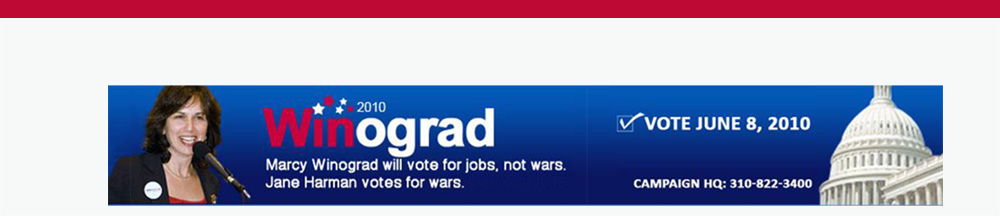
More Background On Winograd4Congress.com
Winograd4Congress.com was the campaign website associated with Marcy Winograd, a Los Angeles-area educator, journalist, peace activist, and progressive Democrat who challenged incumbent U.S. Representative Jane Harman for California’s 36th Congressional District. Most closely associated with Winograd’s 2010 Democratic primary campaign, the site represented more than an online campaign brochure. It was the digital expression of an insurgent political movement that sought to push the Democratic Party leftward on war, healthcare, jobs, civil liberties, environmental policy, and the Israeli-Palestinian conflict.
The campaign took place at a consequential moment in American politics. Barack Obama had been elected president less than two years earlier, Democrats controlled Congress, and progressive activists were debating how aggressively their party should challenge the foreign-policy, national-security, and economic policies associated with the previous administration. Winograd argued that electing Democrats was insufficient if Democratic members of Congress continued to support policies she considered too militaristic, too accommodating to corporate interests, or insufficiently protective of civil liberties.
That made her challenge to Harman particularly notable. Harman was not a vulnerable freshman representative. She was a nationally prominent, well-financed incumbent with substantial institutional support and expertise in intelligence and national-security policy. Winograd was attempting to defeat her from within the Democratic Party.
Winograd4Congress.com served as one of the campaign’s principal tools for explaining why voters should consider doing exactly that.
Who Was Marcy Winograd?
Marcy Winograd entered electoral politics from a background that combined education, journalism, labor activism, Democratic Party organizing, and the peace movement.
She was a public-school teacher and a co-founder of the Los Angeles chapter of Progressive Democrats of America. Her political activism, however, stretched back much further. As a young activist during the Vietnam era, Winograd participated in antiwar activity and became involved with the legal defense effort surrounding Daniel Ellsberg, whose disclosure of the Pentagon Papers became a landmark episode in the history of press freedom, government secrecy, and opposition to the Vietnam War.
Labor activism also formed part of her background. After graduating from the University of California, Winograd volunteered in Delano with the United Farm Workers, the union closely associated with Cesar Chavez. She later incorporated labor, workers’ rights, public education, and opposition to teacher layoffs into her political agenda.
Her journalism credentials helped distinguish her from a conventional political candidate. Winograd had worked in radio news, including at Pacifica station KPFK in Los Angeles, and her campaign biography highlighted broadcasting awards and her involvement in public-affairs programming. She also wrote political commentary and appeared in progressive media.
Education was equally central to the political identity presented to voters. Winograd was a National Board Certified teacher and taught at Crenshaw High School in South Los Angeles. Her campaign consequently presented education policy not simply as another item on a congressional platform but as an issue in which the candidate had direct professional experience.
Together, these roles allowed Winograd4Congress.com to portray its candidate simultaneously as teacher, activist, journalist, Democrat, labor advocate, environmentalist, and peace campaigner.
The 36th Congressional District
The campaign was centered in California’s former 36th Congressional District, an overwhelmingly urban Los Angeles County district that extended through communities on and near the Pacific coast and the South Bay.
Contemporary descriptions of the district placed communities such as Venice and Mar Vista at its northern end and extended it south through the beach cities and areas including Torrance, Lomita, and portions of the Los Angeles harbor region.
Winograd’s 2010 campaign operated from Marina del Rey. Official Los Angeles County candidate records listed her as an educator and gave a Marina del Rey campaign address while specifically identifying Winograd4Congress.com as her campaign website.
Geography mattered politically because the district contained several constituencies central to the campaign’s arguments. Aerospace and defense employment was important in the South Bay, making Winograd’s calls for reductions in military spending potentially controversial. At the same time, the district included environmentally conscious coastal communities, organized labor, progressive Democrats, and voters receptive to arguments about public transportation, green jobs, education, civil liberties, and ending the wars in Iraq and Afghanistan.
The district was reliably Democratic. Consequently, the most important political contest was often not the November general election but the Democratic primary. That provided an opening for Winograd to argue that Democratic voters could use the primary to decide what kind of Democrat should represent them.
The First Winograd-Harman Contest
The political history behind Winograd4Congress.com cannot be understood without the 2006 Democratic primary.
Winograd entered that race as a relatively unknown challenger to Harman, motivated in significant part by opposition to the Iraq War and concern over national-security policies and warrantless surveillance during the George W. Bush administration.
The campaign attracted attention because it exposed a significant ideological disagreement inside the Democratic Party. Harman represented a comparatively centrist and national-security-oriented Democratic tradition, while Winograd appealed to antiwar and progressive activists who believed congressional Democrats had been insufficiently forceful in opposing the Bush administration.
Winograd lost, but her performance established that she had a meaningful constituency. Contemporary reporting put her share at approximately 38 percent of the Democratic primary vote despite a short campaign against a powerful incumbent.
That result gave a later Winograd campaign something many insurgent campaigns lack: evidence that the challenger already possessed a substantial electoral base.
The 2010 Rematch
By 2010, Winograd was no longer simply an unknown activist challenging a nationally known member of Congress.
Her previous showing had demonstrated that a sizable bloc of Democratic primary voters was willing to support her. Her second campaign could therefore be presented as a serious rematch rather than merely a symbolic protest.
The contrast between the candidates remained stark.
Harman was an eight-term incumbent, wealthy, well known, and well connected within Democratic politics. Winograd emphasized grassroots organizing, volunteers, progressive organizations, teachers, union support, peace activists, and door-to-door campaigning.
A Los Angeles Times profile shortly before the June 2010 primary described Winograd personally knocking on doors in Mar Vista while volunteers worked at her Marina del Rey headquarters. The scene illustrated the campaign’s organizing model: direct voter contact supported by a physical headquarters, telephone operations, campaign literature, online communications, and activist networks.
Political analyst Allan Hoffenblum memorably characterized the race as an ideological battle over the Democratic Party itself. That description helps explain the historical significance of Winograd4Congress.com. The website was promoting a candidate, but the larger argument was about what Democrats should stand for.
What Winograd4Congress.com Promoted
Jobs were among the campaign’s most ambitious themes.
Winograd proposed putting millions of Americans to work rebuilding infrastructure, expanding rapid transit, and developing alternative energy. The economic argument was intertwined with an environmental one: government investment could simultaneously reduce unemployment, modernize infrastructure, lessen dependence on fossil fuels, and accelerate a transition toward a greener economy.
The website also emphasized changing federal spending priorities.
Winograd argued that billions spent on wars and military operations should instead support domestic needs such as healthcare, schools, transportation, and employment. This linked her antiwar position directly to economic policy. Ending wars, in her formulation, was not only a foreign-policy objective; it would make resources available for investment at home.
Universal healthcare was another prominent progressive objective. Winograd supported single-payer healthcare at a time when the national debate was dominated by the legislation that became the Affordable Care Act.
Education naturally occupied an important place because of her profession. Her candidacy offered voters the unusual prospect of sending a working public-school teacher to Congress rather than a career politician, attorney, or business executive.
Civil liberties and election integrity were additional themes. Winograd had previously advocated greater scrutiny of electronic voting systems and supported efforts to protect elections against technological vulnerabilities.
The resulting platform was broad but ideologically consistent: reduce military intervention, strengthen public investment, protect civil liberties, support labor, expand healthcare, improve education, develop green industries, and reduce corporate influence over government.
“Your Street Before Wall Street”
The economic populism of the campaign was captured particularly well by the slogan “Your Street before Wall Street.”
It was an effective shorthand for Winograd’s argument that government had become too responsive to powerful financial and corporate interests and insufficiently attentive to ordinary communities.
The slogan also situated the campaign in the aftermath of the 2008 financial crisis. Anger at Wall Street bailouts, unemployment, foreclosures, and economic insecurity was still widespread in 2010. Winograd sought to connect those concerns to local infrastructure, employment, schools, transportation, and public services.
Her proposed green-jobs program therefore functioned as both economic policy and political symbolism: federal resources should build communities rather than primarily finance wars or rescue powerful institutions.
A Grassroots Campaign Against an Established Incumbent
Winograd4Congress.com was aimed particularly at politically engaged Democrats who believed the party needed stronger progressive pressure from within.
Her endorsements reflected that constituency.
Contemporary reporting noted backing from Democracy for America, Progressive Democrats of America, teachers and labor organizations, and antiwar activists. Actor and activist Ed Asner supported her, and figures associated with the broader peace and progressive movements had backed her political efforts.
Her earlier campaign had attracted supporters including Gore Vidal, Tom Hayden, Dolores Huerta, Cindy Sheehan, Jim Hightower, and others associated with antiwar, labor, civil-rights, and progressive politics.
This support did not give Winograd the institutional advantages enjoyed by Harman, but it gave her campaign credibility within activist networks and helped generate volunteer energy.
The campaign’s popularity should therefore be measured differently from that of a national presidential website or major political organization. Winograd4Congress.com served a geographically concentrated congressional campaign, but the ideological issues surrounding the race gave it visibility well beyond the district.
National progressive publications and organizations followed the contest because it was viewed as a test of whether activists could successfully challenge a sitting Democrat from the left.
Campaign Money and the Power Imbalance
Money was one of the campaign’s major structural challenges.
Harman possessed substantial resources and entered the contest with the advantages of incumbency, national political relationships, and established name recognition. Contemporary reporting after Harman's eventual departure from Congress noted that she had spent approximately $1.3 million on her 2010 reelection campaign.
Winograd’s political identity, by contrast, emphasized grassroots participation and smaller contributors.
The financial imbalance reinforced the central narrative promoted through Winograd4Congress.com: this was an activist campaign attempting to overcome institutional power through organization, volunteers, voter contact, political argument, and online mobilization.
That imbalance also helps put Winograd’s final result into perspective. She did not defeat Harman, but she won more than two out of every five votes cast in the Democratic primary.
The Official 2010 Result
The June 8, 2010 California primary ultimately returned Harman to the Democratic nomination.
Official California election results recorded 27,146 votes for Jane Harman, or 59.1 percent, and 18,792 votes for Marcy Winograd, or 40.9 percent.
For Winograd, the 40.9 percent result represented an improvement over her showing in her earlier challenge and demonstrated the persistence of a substantial progressive opposition to Harman within the district.
For Harman, the victory was decisive enough to retain the nomination but came only after an unexpectedly serious challenge from within her own party.
Contemporary press coverage noted that Harman had been compelled to actively campaign and advertise against Winograd. In that respect, the challenger had succeeded in forcing a well-established incumbent to defend her record and respond to arguments coming from the Democratic left.
Foreign Policy and Israel
Few issues made the contrast between Winograd and Harman sharper than foreign policy.
Winograd strongly opposed the wars in Iraq and Afghanistan and favored reducing military expenditures in favor of diplomacy and domestic investment. Her views on Israel and the Palestinians were particularly controversial.
Winograd, who is Jewish and helped found LA Jews for Peace, was a vocal critic of Israeli government policies toward Palestinians. She advocated Palestinian rights and, during this period, supported a single democratic state in which Israelis and Palestinians would possess equal rights.
Those positions generated substantial opposition, including criticism from prominent Democratic supporters of Israel. Harman’s campaign used Winograd’s Middle East views in political advertising, while Winograd argued that criticism of Israeli government policy was consistent with advocating human rights and peaceful coexistence.
The dispute became one of the most widely discussed elements of the race, especially following the May 2010 Gaza flotilla confrontation. Publications ranging from the Los Angeles Times and LA Weekly to Jewish and progressive media examined the candidates’ sharply different positions.
This controversy expanded the campaign’s significance beyond local congressional politics. The primary became part of a larger argument over how much dissent regarding U.S.-Israel policy existed—or should exist—inside the Democratic Party.
Press and Media Coverage
For a congressional primary challenge, Winograd received considerable media attention.
The Los Angeles Times covered both her 2006 and 2010 campaigns and examined the ideological contrast between Winograd and Harman. Democracy Now! interviewed Winograd during her first congressional challenge, giving her a national progressive audience. The Nation treated the Harman-Winograd contest as one of the noteworthy Democratic primary battles of the period.
Jewish media followed the race closely because both candidates were Jewish yet represented dramatically different perspectives on Israel and the Palestinians. Progressive publications likewise followed Winograd because of her antiwar views, labor connections, and criticism of corporate power.
The amount and diversity of this coverage demonstrate why Winograd4Congress.com has historical interest beyond the ordinary lifespan of a losing congressional campaign site. It documented a candidate situated at the intersection of several debates that would become increasingly important in Democratic politics during the following decade.
Awards, Recognition, and Professional Credentials
Unlike a restaurant, tourism, or entertainment website, Winograd4Congress.com did not revolve around consumer awards, menus, or conventional reviews. Its relevant forms of recognition were political, journalistic, educational, and organizational.
Winograd’s campaign biography highlighted her recognition by the Los Angeles County Democratic Party as a “Democrat of the Year.” It also emphasized her broadcasting background and awards for news writing and broadcasting.
Her National Board Certified teacher status provided another important professional credential.
These distinctions helped the website make a broader argument about qualifications. Winograd was presenting herself not as an outsider with no relevant public experience, but as someone whose experience had been accumulated through education, journalism, labor, activism, community advocacy, and Democratic Party work rather than elected office.
The Website’s Audience and Purpose
Winograd4Congress.com had several overlapping audiences.
The most important consisted of Democratic voters in California’s 36th District who could actually determine the primary. The site needed to introduce Winograd, contrast her record with Harman’s, explain policy positions, recruit volunteers, and encourage political participation.
A second audience consisted of progressive activists outside the district. Their endorsements, donations, publicity, and volunteer networks could help an underfunded challenger compete with an incumbent.
A third audience was the media. Campaign websites provide journalists with biographies, policy statements, quotes, endorsements, event information, and official campaign positions.
Finally, the website helped build Winograd’s political identity independently of any particular election. That became important after 2010.
What Happened After the 2010 Campaign?
Winograd’s political story did not end with the June primary.
In February 2011, Harman announced that she would leave Congress to become president and CEO of the Woodrow Wilson International Center for Scholars. Her departure suddenly transformed the 36th District from a safely held incumbent seat into an open-seat contest.
Winograd again became a candidate.
The 2011 special election attracted a crowded field, including Los Angeles City Councilwoman Janice Hahn and California Secretary of State Debra Bowen. California’s certified candidate list described Winograd as a high-school teacher.
Contemporary coverage noted that her previous campaigns had given her a committed following, although Hahn and Bowen entered the special election with broader institutional and financial advantages. Early campaign-finance reporting showed Winograd raising more than $50,000, with more than half coming from small individual donations.
Her continued candidacy demonstrated that the organization and political identity developed during the Winograd4Congress.com era had survived the 2010 defeat.
Cultural and Political Significance
In retrospect, Winograd’s campaigns resemble a style of Democratic insurgency that became much more visible later in the 2010s.
The model is now familiar: a progressive challenger contests a Democratic primary, criticizes corporate influence, emphasizes small donors and volunteers, promotes universal healthcare, challenges military spending, calls for major public investment, and argues that safe Democratic districts should elect more progressive representatives rather than simply preserve incumbency.
Winograd was campaigning on several elements of that formula years before progressive primary challenges became a major national political phenomenon.
That does not mean her campaign directly created the later movement. It does mean Winograd4Congress.com provides a useful historical snapshot of ideas, strategies, and internal Democratic tensions already visible in Southern California in 2006 and 2010.
The campaign also illustrates the growing importance of political websites during the transition from traditional campaign communications toward digitally organized politics. A congressional challenger could use a website to publish positions without relying on newspaper coverage, reach activists nationally, recruit volunteers, solicit contributions, respond rapidly to an opponent, and preserve a detailed political identity online.
Why Winograd4Congress.com Remains Historically Interesting
Winograd4Congress.com is ultimately the surviving digital footprint of an unusually energetic congressional primary challenge.
The campaign did not achieve its immediate objective. Marcy Winograd never unseated Jane Harman. But measuring the website only by the election result misses much of its historical value.
It documents a period when progressive Democrats were actively challenging their own party over Iraq and Afghanistan, surveillance and civil liberties, healthcare, Wall Street, environmental policy, military spending, labor rights, and the Israeli-Palestinian conflict.
It also records the political development of a candidate who demonstrated that an activist and public-school teacher could mount a credible challenge against a nationally prominent incumbent. Winning 40.9 percent of the 2010 Democratic primary vote was not victory, but neither was it politically insignificant.
For researchers looking back at American progressive politics before the rise of later nationally prominent insurgent congressional campaigns, Winograd4Congress.com offers a revealing case study.
It represents a campaign built around a straightforward proposition: voters in a safely Democratic district did not merely have to choose between Democrats and Republicans. They could use the Democratic primary itself to debate war and peace, corporate influence, economic priorities, civil liberties, environmental policy, healthcare, education, and the ideological direction of their party.
That debate was the real subject of Winograd4Congress.com—and it is what makes the site a noteworthy piece of Southern California political and internet history.